SOON OUT OF CONTEXT
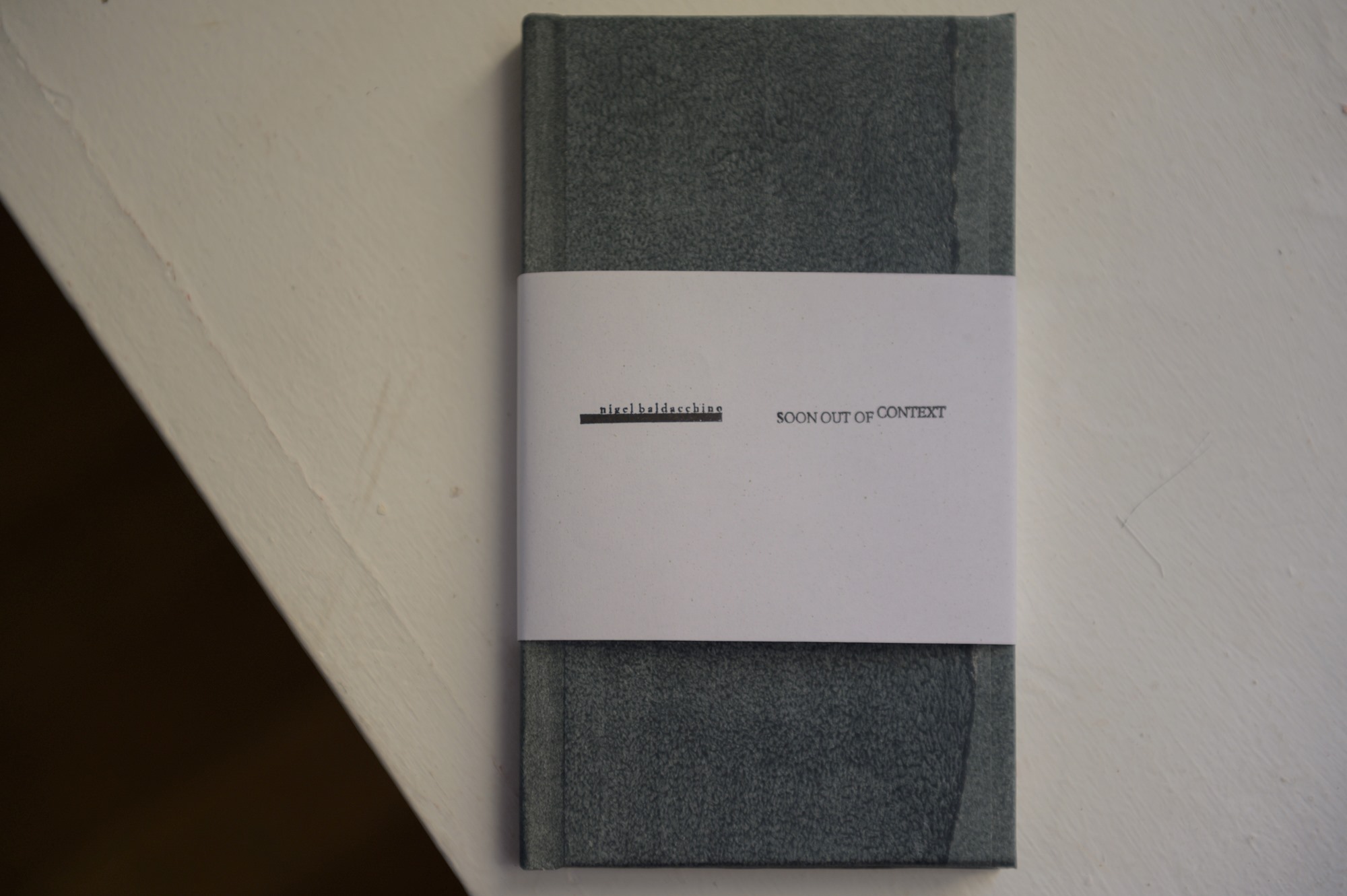
soon out of context (UNSOLICITED PRESS, 2019) is a BOOK CONTAINING INSTANCES OF FOUND IMAGES SOURCED FROM LIBRARY COLLECTIONS IN DIALOGUE WITH THE AUTHOR’S OWN FRAGMENTARY WRITTEN PIECES.
THE BOOK WAS PUBLISHED IN TWO EDITIONS: AN OPEN EDITION & A LIMITED EDITION DESIGNED BY THE AUTHOR.

It is of course a truism to say that today we live in an age of distraction: the ceaseless likes, clicks and swipes that impinge on our digital consciousness, the multitudinous, myriad, manifold memes, GIF, tweets that bombard our existence. Instead of our nights lit by the starry constellations, our nocturnal existences are illumined by the glows of our smart phones.
Nigel Baldacchino’s Soon Out of Context is a child of this age but it is a rebellious one. It is a child of our age because its sources was culled from the internet, in a site fittingly entitled archive.org, and also because of its miscellaneous nature. But it is also rebellious because as he combs through the archives of our age, he seeks to return us to a more nostalgic, simpler time (of course all nostalgias are imaginary and possibly fictive): he summons the lambent, golden haze world of the once dusty books that you could only find in community libraries, bric-a-brac antique stores, yellowed periodicals that you find in your great aunt’s attic.
The images that the reader will encounter in the following pages are whimsical, haunting, lyrical, slightly (if that is the right adverb) surrealist, even Dadaist. But the presiding angel of these pages is a calm, beneficent one, rather than a terrifying one of, say, Rilke in the Duino Elegies, or perhaps more fittingly, Benjamin’s and Klee’s mischievous and apocalyptic Angelus Novus. What is the relationship between the text on the verso and images on the recto? For me, white space is a visual fermata, a breath, a moment for meaning to sink in or for the imagination to generate it.
“What is decisive in collecting is that the object is detached from all its original functions in order to enter into the closest conceivable relation to things of the same kind. . . Collecting is a primal phenomenon of study: the student collects knowledge,”
Walter Benjamin, writes in the Arcades Project. There is a danger that in collecting scrapes of images randomly that this “hoarding” becomes obsessive and messy. But Nigel manages to remain serene, elegant, and elevated in this oneiropoietic experiment. He is the student of memory that collects dreams.
PREFACE BY PROF Andrew Hui
ISBN-10 : 1947021842
ISBN-13 : 978-1947021846
 nigel baldacchino